Tuesday, July 9, 2013
Kudzu Bugs
Pictured above are Kudzu bugs on a soybean plant at the agricultural research facility of the University of Georgia. Kudzu bugs migrated to the American southeast in 2009 and they are considered a major problem in crop production. They rob plants of nutrients and water with their piercing-sucking mouthparts; this causes significant yield loss. Kudzu bugs primarily feed on legumes such as kudzu or soybeans. According to the North Carolina State University Extension, these pests can cause up to 75% yield loss!!!
Georgia was a fun territory because of the diversity in crops. Most states I've been to are focused on corn, soybeans, rice and cotton. Georgia had pecan and peach trees, tobacco plants, vegetables such as cucumbers, squash, and onions, and fruit fields of cantelope. Everyone I met at different distributors was friendly and welcoming. I learn something new from every person I meet - one of the many reasons I love the South!
Monday, July 1, 2013
Texas
Last week I was in Texas traveling around cities like Dallas, San Antonio, and Abilene. It was a different territory because there are more cotton acres and sunflower fields (I've primarily seen corn, soybeans, and rice). For anyone who has never been to the great state of Texas - it is just like the movies. Tumbleweed flying across the highway, interstate speeds at 80mph, catus on the side of the road, cowboy hats, and it's about 103 degrees.
This internship has allowed me to explore beautiful places across the southeast. I have learned more about the agriculture business in a month than many students learn in a semester of college. I still have so much to learn! In this business it is helpful to know a little bit about everything including economics, soil science, entomology, plant science, business, sales and marketing, chemistry, basic measurements, farming practices, manufacturing, and agriculture news.
The communication among FMC representatives is both vital and impressive. The guys in different territories are consistently calling, texting, and emailing each other pictures, data, and information. Also, there is strong contact between corporate headquarters and the sales managers actually out in the field. This is so important because product makers need to know about customer needs.
I've realized that if you don't see purpose in what you are doing then you will probably lack a sense of direction or enthusasiam for each day. Everything is connected. We go to work each day to receive a paycheck to pay for the grocery bill that wouldn't exist if there wasn't an agriculture business.
Monday, June 24, 2013
Food for Thought
Let's face it, pesticides have a bad reputation worldwide. People like to blame the agricultural chemicals for loss of species, human health issues, and environmental problems in general. Since beginning my internship I have seen both sides of the story. There are labels, rates, and restrictions on all products to protect humans and nature alike from misuse or carelessness. FMC is big on safety; everywhere I go the first thing I hear about is safety knowledge and behavior. Just thinking about what you do before you do it can make all the difference. I'm reading a book right now called "Saving the Planet with Pesticides and Plastic" by Dennis Avery. He writes,
"Pesticides are a vital element of the high-yield farming systems that are already saving more than 15 million square miles from being plowed for food production. By 2050, pesticides and fertilizers could be helping to save from plow-down as much as 30 million square miles of forests, prairies, and other prime wildlife habitat."
That is a huge statement! If we produce higher yields then we get more food with less land. If we don't get the high yields then we plow down millions more acres of land to expand farming. Wildlife species lose their homes when we plow down more land. So, why wouldn't we fully utilize the land we already have? You cannot get the high yields without the chemicals. That's just some food for thought.
"Pesticides are a vital element of the high-yield farming systems that are already saving more than 15 million square miles from being plowed for food production. By 2050, pesticides and fertilizers could be helping to save from plow-down as much as 30 million square miles of forests, prairies, and other prime wildlife habitat."
That is a huge statement! If we produce higher yields then we get more food with less land. If we don't get the high yields then we plow down millions more acres of land to expand farming. Wildlife species lose their homes when we plow down more land. So, why wouldn't we fully utilize the land we already have? You cannot get the high yields without the chemicals. That's just some food for thought.
Wednesday, June 19, 2013
Bootheel Missouri
This week I am in Portageville, Missouri. This a very small town with a population of about 3,000 people. It has so much character and history, and it is located along the Mississippi River. I drove around today to take some pictures. I try to enjoy each place I go. I have realized that there is beauty in all things: big or small, simple or fantastic, colorful or dull, old or new. You just have to open your eyes and take the time to appreciate them! ;)
Friday, June 14, 2013
Corporate Headquarters in Philly
I spent this week in Philadelphia, PA where the corporate headquarters of FMC is located. I flew in on Monday with other interns from around the country. We had meetings throughout the day and discussed commercial sales, manufacturing, registration, safety, marketing, etc. At night we had time to explore and enjoy the city! My conversations with people have made me realize the many great qualities of this company. FMC values family, challenges, adaptability, and developing skills. I love so many things about FMC, and I see that it is a wonderful place to work.
Philly was fast paced; people are busy and the skyscrapers can make you feel insignificant from 56 floors below. However, the sense of urgency makes you feel alive. I was born and raised in the southeast so Pennsylvania was a different world for me. This internship has given me the opportunity to travel around the country and meet new people, explore new places, and challenge myself with unfamiliar experiences which in return have made me grow.
Tuesday, June 4, 2013
Wheat
FMC has research plots at the Agriculture Center in Memphis, TN. When I first began my internship I visited some wheat trials. Our "tech service" guys use the plots to run tests with different chemical responses vs. untreated crops.
The picture above shows an untreated plot on the left and a treated plot on the right. The reason that they are so dramtically different is because of a process called "lodging" in wheat. Rye grass is considered a huge problem in wheat and is the reason for lodging; the wheat falls over to the ground and cannot stand up straight. When this happens the crop is difficult to harvest, the yield is decreased, and the farmer loses both time and money. FMC's goal is to get a label for a post application to protect wheat.
Monday, June 3, 2013
Marvel in Arkansas
The picture above is a soybean plant. You can see the burn from the chemical on the plant - this is a GOOD thing! It means the chemical is working on the weeds that surround the crop rows. The chemical kills the weeds, but does not hurt the actual soybean. Each product that FMC distributes has a label that has been approved by the Environmental Protection Agency (EPA). Also, each product has a specific "rate" at which the grower sprays each acre.
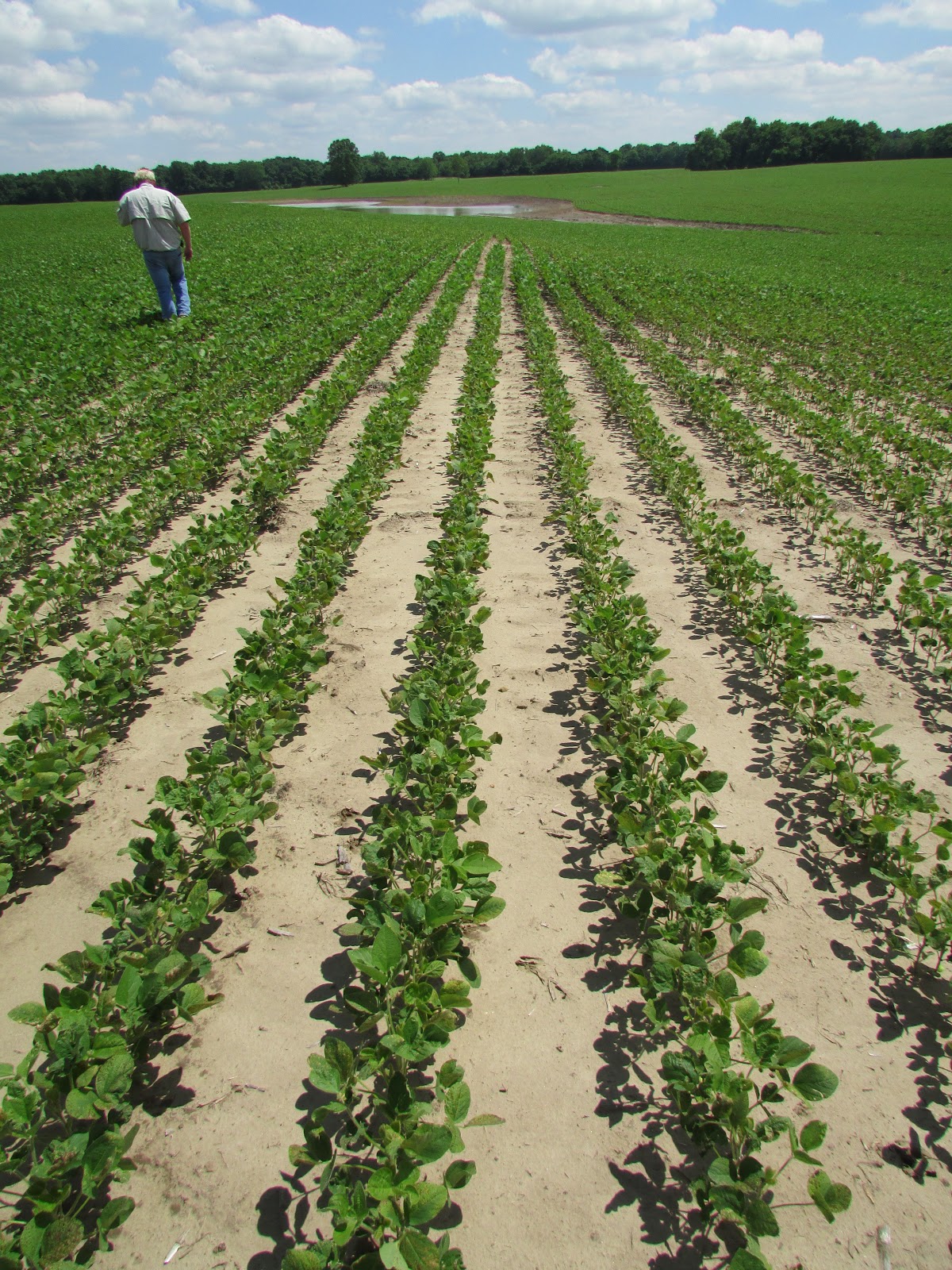
These are some good lookin' soybean plants that have been treated with Marvel!
Subscribe to:
Posts (Atom)