Friday, November 8, 2013

What does FMC stand for?


I am often asked, “What does FMC stand for?” Well, here is the story behind our brand.
“FMC was founded in 1883 and was originally known as the Bean Spray Pump Company, named after John Bean who developed the first piston pump insecticide sprayer. Success followed and, after acquiring another company, the named was changed to Food Machinery Corporation, which soon became Food Machinery and Chemical Corporation and eventually became known as FMC Corporation.” (www.fmccrop.com)

What does it really mean to build a brand? I think it means having all of your employees excited and engaged with the products or services they sell. I think it means development of social media advancement, communications, marketing initiatives, and network relationships. FMC is the fastest growing company in our industry, and I know we will continue to pursue building our brand name to reach as many people as possible.


Tuesday, November 5, 2013

Marketing Associate

Since my last post I have moved 1,100 miles away from home to live in the great city of Philadelphia, PA. I am a new Marketing Associate with FMC Corporation! I will be working specifically with segment planning, social media advancement, and communications. I am very excited to begin what will hopefully be a life-long career with this company. I miss the southern region, but I am so appreciative of all that I learned during my sales internship experience. My goal for this new position is to learn as much about business strategy, marketing analysis, and product development as possible.

Happy Tuesday!


Monday, September 16, 2013

Display (TM)

"The newest cotton harvest aid for cotton growers who demand reliable defoliation with less regrowth and rapid control of viney weeds. Display is a PPO that comes as a concentrated, low-use rate formulation. It delivers excellent results even in cool temperatures, and tank mixes easily with adjuvants and other harvest aid chemistries." -Taken from www.fmccrop.com  


The featured fields are in Isola, Mississippi. As you compare the two pictures above, you probably can see a distinct difference. The top picture was taken just 36 hours after the cotton field was sprayed and the bottom picture was taken exactly 7 days after. The results of Display (TM) cotton defoliant are remarkably fast - which is very important when seasons are changing and the crop was planted late. Display (TM) has consistently shown positive results while saving growers up to 4 days harvest time! 

And time is money.  

Tuesday, September 3, 2013

The Dreaded Pigweed


    This is the dreaded pigweed. A plant feared and faced in any region of the United States with a growth hormone faster than a racecar. It is a summer annual that germinates from late winter through summer season. It grows incredibly fast and spreads like wildfire; seeds spread inch by inch to cover an entire field. If farmers don't carefully clean their machines they could potentially ruin a clean field if just one tiny pigweed seed hits the ground. They are nitrate-accumlating in certain environmental conditions. Nitrate is found in fertilizer, but too much can be posionous. The weed can be killed by herbicides if it is caught young (and I mean smaller than 3 inches tall). However, once that baby hits 4+ inches you can forget about it.

   The pigweed especially interests me because of its growth potential. I have seen a one inch pigweed on a Monday and by the end of the week it was up to my hip! Once the weed takes over it is hard to distinguish your crop and weed regrowth becomes a problem later on.


   The weeds on the left have not invaded the corn on the right because the corn has been sprayed with some Anthem (TM) herbicide to protect it. This is just a great example of what I've seen all summer from Texas to North Carolina. One thing I'd like to research is possibility for transforming pigweeds into biofuels. A plant this strong should be manipulated for benefits - we just need to figure out how to do it!

Monday, August 19, 2013

Curry Farms


Along my journey I met the Curry family who reside near Rayville, Louisiana. Mr. Bentley and his delightful wife Sandy open their home to their community each year. They have lived on this farm for most of their lives and have created a wonderland. You should see how beautiful it is!


There are pumpkin patches in their backyard. Also, they farm Christmas trees!! They invite friends, family, and community members to come and celebrate the fall season. People come from many miles away to gather a Halloween pumpkin and an authentic tree for their home.


There are goats, donkeys, chickens, and other critters roaming around. They love attention, and food of course. When I become a home owner later in life I hope to have several acres and lots of wildlife to share my afternoons with.


Last but not least there is a huge catfish pond! Perfect resource for a fish fry or relaxing on the dock. Their home is also open for birthday parties and carnival get-togethers! I just had to share these pictures because I had such a good time exploring. If you'd like more information about Curry Farms, please visit   http://www.curryfarms.net/CURRY_FARMS/HOME.html


Happy Monday!

Tuesday, August 13, 2013

Rice Field Days


So that's me in a rice field near Stuttgart, Arkansas last week. I was there for a rice field day put on by the Arkansas Agricultural Experiment Station. People from all parts of the community gathered at the Grand Prairie Center for free give-aways, informational booths, provided lunch, and rice plot tours. It was really a great networking event! Throughout the summer I have realized how important it is to reach out to anyone and everyone around you. If you're on a plane you should definitely introduce yourself to the person next to you - you never know who you are sitting by!!


Above is a rice plot. We talked about different rice varieties; which ones prosper in a range of temperatures, which ones battle disease well, which ones support high yields, etc.


Rice is a crop that is flooded - we actually want standing water (which is a disaster for most other crops). The piled up dirt surrounding the plots are called levees. They support the water and guide it along with gravity from the highest point in a field to the lowest point.


The leaves pictured above feature a disease called sheath blight. If this disease takes over the crop, a grower would be facing yield loss of up to 25% or greater! Not only do dollar signs raise a red flag, but the quality of the rice is also compromised after facing disease.

I'm sure glad there are chemical corporations out there to safely protect our food, right? ;)


Monday, August 5, 2013

Cotton was king!

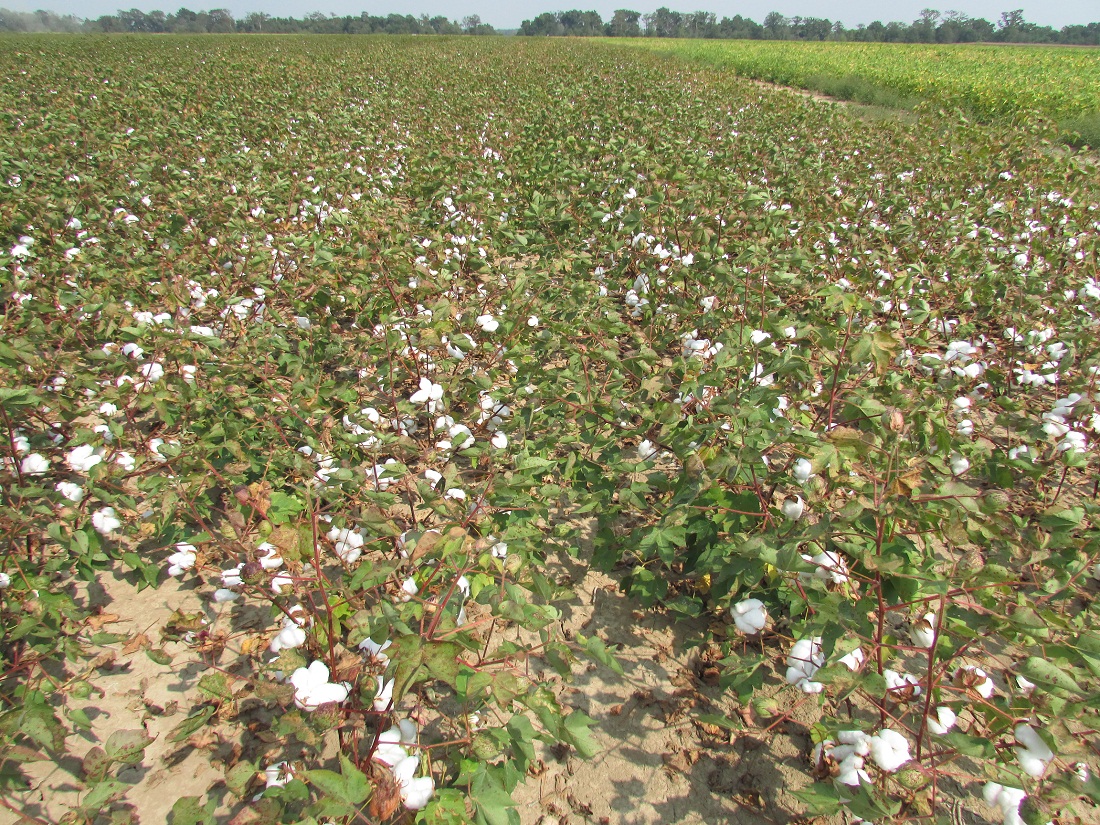
Cotton was once king of the south, but that has changed throughout the years. Cotton is like a small child; it requires constant upkeep, tender care, and is expensive. Cost per acre can easily exceed $500 along the growing season. While I was in Arkansas I learned that just two short years ago, total cotton acres for the state was approximately 518,000. Today, Arkansas features about 350,000 acres. There are cotton gins across the south with worry on their face.

www.cotton.org states, "U.S. textile mills have spun almost 5 million bales of cotton on average for the past 3 years (2006-2008). That's enough cotton to make over 1 billion pairs of jeans."

I cannot stress how important cotton is. "One bale of cotton can make 1,217 men's T-shirts or 313,600 $100 bills." The crop is also responsible for the creation of an immense amount of biofuels. The United States historically exports about half our cotton to other countries around the world - imagine the money that brings into our economy!

Cotton has several growth stages. I am learning about them as we prepare for cotton defoliation season. Defoliation means taking all the leaves off the plant so that the cotton can be cleanly and easily harvested at maximum yields.


As you can see the flower blooms white, then turns red, and a cotton boll is revealed. The boll opens up over time and gives us mature cotton. Cotton can take anywhere from 130 - 160 days to complete this process.


Above is a picture of a boll weevil. "The boll weevil is the primary insect enemy of cotton. An adult is ¼ to ½ inch long, appearing tan to dark brown or gray in color, has a hard humpback-shaped shell and the characteristic snout accounting for about ¼ of its length. This pest has plagued U.S. cotton producers since 1892. It can complete an entire lifecycle in three weeks, lay 200 eggs per female–each in a separate cotton square or boll, ensuring the destruction of each–and spread rapidly, covering 40 to 160 miles per year. (www.cotton.org)"

Knowledge is power, folks!